
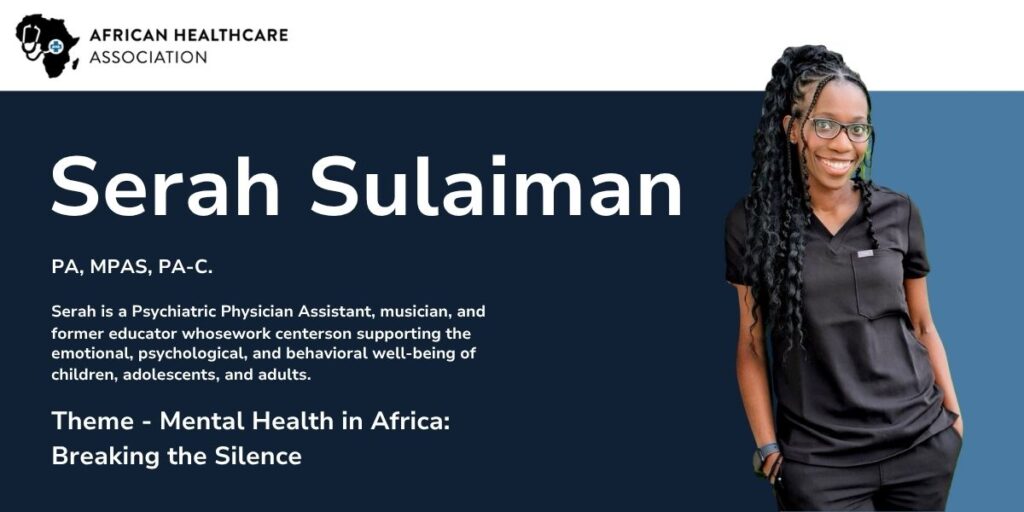
On March 25, 2026, I had the honor of guest speaking with the African Healthcare Association and leading a discussion on breaking the silence around mental health in Africa and why this conversation matters now more than ever.
Mental health is not separate from health. It is health.
When we talk about mental health, we are talking about how people function in their families, in schools, in workplaces, and in communities. We are talking about stability, dignity, and long-term system strength.
High Levels of Unmet Need
Across many African countries, and similarly in the United States, the need for mental healthcare continues to exceed available resources. Mental health conditions are common and treatable, yet access to consistent and coordinated care remains uneven.
During the discussion, an important question emerged: Where are the gaps in continuity of care?
Participants highlighted that while diagnosis and initial treatment may be accessible in some settings, ongoing follow-up, structured monitoring, and coordinated support are often lacking. Continuity of care remains one of the most significant gaps.
Workforce shortages further compound this challenge. With limited numbers of psychiatrists, psychologists, and psychiatric nurses, and minimal integration of advanced practice providers such as physician assistants and nurse practitioners, systems are stretched thin, making sustained care difficult.
Cultural Stigma and Barriers
Another key question raised was: How is mental health viewed in your country, and how do we know when someone is “mentally healthy”?
The responses revealed deeply rooted cultural dynamics. Many African households still struggle to talk openly about mental health. Social norms often emphasize resilience, endurance, and emotional restraint, where vulnerability may be perceived as weakness. As one participant shared, many people are taught to “be tough” and, as a result, suffer in silence rather than seek help.
Others reflected on how mental health feels more personal and exposed than physical health, making it harder to discuss openly. In some regions, mental illness is still associated with shame or spiritual causes, which can delay individuals from seeking appropriate care.
In Northern Nigeria, for example, participants noted that stigma, combined with limited access to services and reliance on traditional or spiritual healing, continues to create barriers to timely and effective treatment.
Reducing stigma, therefore, requires more than awareness. It requires systems that make mental healthcare visible, accessible, and normalized within everyday care.
Integration Into Primary Healthcare
A recurring question was: How can these challenges be addressed in practical terms?
One of the most promising solutions is the integration of mental health into primary healthcare. When screening and basic treatment are embedded into routine care, access improves, and stigma is reduced. Care becomes part of everyday health, rather than something separate or exceptional.
Integration must also include workforce development and culturally responsive approaches that acknowledge existing beliefs while improving access to evidence-based care.
Mental Health in the Diaspora
Participants also raised an important concern: What strategies can encourage Africans in the diaspora to seek mental healthcare?
Even in settings where mental health services are more available, stigma persists. While systems may screen for mental health conditions, many individuals remain hesitant to speak openly. This is particularly true among adults, while younger generations may be more open but still face cultural silencing.
Additionally, participants from Rwanda highlighted the lasting impact of trauma and PTSD, noting how these experiences can manifest in diaspora communities, sometimes alongside conditions such as addiction. These insights reinforce the need for culturally informed, trauma-aware care models that extend beyond geographic boundaries.
Innovation in Care Delivery
Innovation in mental healthcare does not have to rely on expensive infrastructure. Across Africa, there is a unique opportunity to design systems intentionally.
Digital tools, telehealth, and community-based care models can help extend access, particularly in underserved areas. When combined with culturally grounded education and local leadership, these approaches can support scalable and sustainable solutions.
At the same time, mental healthcare must remain human-centered on the lived experiences of individuals and communities.
A Broader Reflection
Strengthening mental healthcare is not about importing external models. It is about building systems that are accessible, culturally grounded, and sustainable. The discussion made one thing clear: mental health is not just a clinical issue but a societal one. It affects how people learn, work, parent, and engage with their communities. When mental healthcare systems are strong, communities are stronger.